Share in our discoveries across three projects as we work to provide the first intellectual access to our hidden treasures relating to work and labor in early 20th Century New England, the 1939-1940 New York World's Fair and its period, and Boston local TV news.

Showing posts with label Amateur Film. Show all posts

Monday, October 31, 2011

Fair License

In 1938, with construction on the fairgrounds underway, the New York World’s Fair began to edge its way into the frame of everyday life for New Yorkers throughout the state, as we see in this frame enlargement from a 1938 home movie in Northeast Historic Film’s Cyrus Pinkham Collection.

Credit: Cyrus Pinkham Collection, Northeast Historic Film

As reported in a January 17, 1938, Time Magazine article, “debonair, voluble Grover Whalen, Manhattan's perennial greeter and president of the Fair, last year sold New York's Governor Herbert H. Lehman the idea of stamping...all 1938 automobile license plates [with] the phrase NEW YORK WORLD'S FAIR 1939.” Whalen asserted that "Surely every automobile owner and driver in the State of New York should welcome the opportunity to act as an ambassador of good-will for the Empire State."

In his 2010 book, Twilight at the World of Tomorrow: Genius, Madness, Murder, and the 1939 World’s Fair on the Brink of War, James Mauro observes that not every New Yorker was happy to be part of Whalen’s promotion machine:
Most citizens took the news in stride, yet if there was any indication of New York’s flippant attitude about the Fair, it came in the grumblings of drivers who wondered why they were being forced to carry free advertising on their cars.

One particular cynic, a forty-two-year-old mechanic from White Plains named Martin McBohin, expressed his displeasure by covering up the offending ad with electrical tape and subsequently got himself arrested for defacing a license plate. Before his trial, he announced to the press, “Next thing you know, the State will compel us to advertise someone’s corn flakes.”

Credit: Cyrus Pinkham Collection, Northeast Historic Film

Saturday, October 15, 2011

Home Movie Day, The First at Queens Museum of Art

International Home Movie Day (the ninth annual) took place on Saturday, October 15.  "Moving Images 1938-1940: Amateur Filmmakers Record the New York World's Fair and Its Period" held Home Movie Day at the Queens Museum of Art, with stupendous support from the Museum, led by Curator Louise Weinberg, Prerana Reddy on PR, Danny and Arnie on the physical details, and the New York City pavilion from "our" fair as the location.  


Walter Forsberg (NYU Research Fellow), Brian Graney and Karin Carlson (Northeast Historic Film), Alice Moscoso (NYU Film Preservation Specialist), and Katie Trainor (Museum of Modern Art Department of Film), all Home Movie Day veterans, organized. Katie is a Center for Home Movies board member and co-founder; Molly Wheeler (Yale Univ. Beinicke Library) is another HMD co-founder.   

This amazing crew of students from the New York University Moving Image Archiving and Preservation Program provided staff support for the entire day. Particular thanks to the film inspectors and the projectionists: Matt Barry, "The Art and Culture of Movies", http://artandcultureofmovies.blogspot.com and Zack Lischer-Katz, Archive Assistant at NYU's Cinema Studies Film Study Center. NYU professors Howard Besser, Dan Streible, and Mona Jimenez attended, too. Thank you, all.    

Individuals with home movies arrived before noon and kept coming. Many had heard about the event on WNYC radio as Leonard Lopate interviewed Walter Forsberg and Louise Weinberg on Oct. 14. Leonard has great listeners who can find their home movies with less than a day's notice. Listen here.   


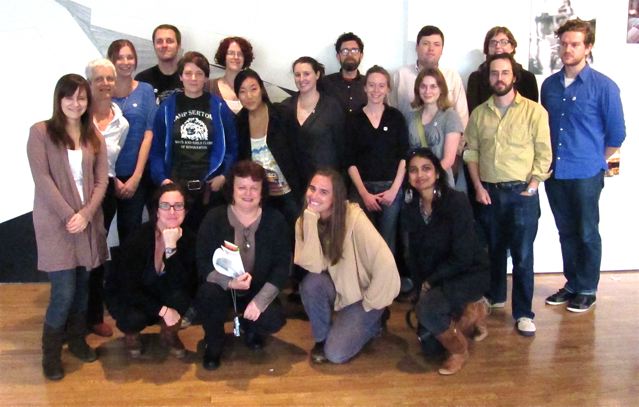
We saw Kodachrome family fun, a 16mm 1953 wedding--a surprise to the son who brought it, both the 1939-1940 and the 1964 NY World's Fairs, Miami, Havana, teen birthday dancing (1960s), 8th grade graduation, lakes, Fire Island, and new NY highways (many people shot out their windshields). We enjoyed a special guest appearance by the film of Gus Martens, brought by his grandson, Robert Martens, who introduced. Gus Martens was an Amateur Cinema League Member. Mr. and Mrs. Martens talk to Walter Forsberg, below. 
Do you have home movies? Please consult these FILM PRESERVATION LINKS.

Friday, August 19, 2011

A Camera Chart for the Fair

The Amateur Cinema League's Movie Makers periodical published a "Camera Chart," actually an annotated schematic map, for the New York World's Fair in 1939. Cataloger Brian Graney identified and prepared the map as a signature element of our access and interpretive tools.

Website visitors will be able to use the map to browse amateur films by fair zones. The map, a two-page spread in the large-format magazine with another column identifying camera-worthy fair features, is also available for download as a PDF.

Locations on the map are numbered, for example at site 27, "The Parachute Jump will let you film while you are jumping." We have not yet noted a reel capturing a falling cameraperson.

Perhaps such reels will appear at the Home Movie Day event scheduled for Saturday, October 15, at Queens Museum of Art, in Queens, NY, from 1 to 5 p.m.

Home Movie Day at Queens Museum of Art is free to the public; anyone who has amateur film from the 1939-1940 fair, who attended the fair, and people of all ages interested in learning more about amateur film, please write to be added to the mailing list for our Home Movie Day event: brian@oldfilm.org

Wednesday, June 22, 2011

The Amateur Cinema League and New York World's Fair Policies, 1938

Roy W. Winton, managing director of the Amateur Cinema League, wrote to W. Earle Andrews, the general manager of the New York World's Fair Corporation, in April 1938. Winton had heard rumors from an Amateur Cinema League member that fellow amateur cinematographers would be charged for filming at the World's Fair, set to open in a year.

Stephen F. Voorhees was the Board of Design chairman for the fair. He was also the president of the Amateur Cinema League. He weighed in with a memo to Andrews reporting on a meeting where it was concluded that "amateur movie makers should have the same unrestricted privileges as amateur still picture takes. I believe this was the rule at Chicago and also at Paris--at least nobody held me up while I was taking moving pictures." Voorhees's memo is noteworthy in several respects. First, it's evidence that he took films at fairs, as we infer that he was shooting at the Chicago World's Fair in 1933 and perhaps also at the 1931 Exposition coloniale internationale in Paris.

The managerial interest in adhering to precedent, both in practice--one could film and not be "held up" at prior fairs--and in policy leads us to consider the trail of regulations for visual recording at world's fairs. What were the explicit policies, and how were they determined and enforced? For the 1939 NYWF we have a four-document trail of evidence in the New York World's Fair 1939 and 1940 Incorporated collection, Manuscripts and Archives, NYPL. In his memo Voorhees concludes, "It was my understanding that the agreement at the Management Council Meeting was to the same effect with respect to charge--that is, there was to be no charge for either the still or movie amateur non-commercial picture taking." The double emphasis on "amateur non-commercial" is not clear, although one reading is to cover both the creator being an amateur and filming with that explicit status, and the subsequent use of any film created by that person of amateur status would be only non-commercial, sharing among friends, family, and club members.

W. Earle Andrews then wrote to Winton at the ACL telling him that cameras in the hands of individuals using them for amateur purposes and not for commercial exploitation will be permitted. Roy Winton concluded the correspondence on May 4 with a letter on Amateur Cinema League letterhead thanking Andrews and calling attention to the ACL monthly periodical Movie Maker's coverage of the fair: "Our interest in the Fair is very genuine. I am sure that you have seen the number of our monthly magazine, MOVIE MAKERS, with an article, illustrated in natural color, covering the many things of interest that amateur movie makers will find in the New York World's Fair 1939."

A later article in Movie Makers, four months into the fair, "Movie tripods at the New York World's Fair" (August 1939), recounts friction between the fair management and amateur cinematographers around regulations prohibiting tripod use at the fair. "The regulations, adhered to because of contractual relations between the fair and the Official Motion Picture Photographers concession, were withdrawn actually at the request of the concessionaires, themselves, because of their desire to place no obstacles in the way of complete amateur recording of New York's mammoth exposition."

Correspondence 28 April-May 4, 1938. New York World's Fair 1939 and 1940 Incorporated, Corporation Policies, Box 122 Folder 7, Movie Cameras--Amateur (1939), Manuscripts and Archives Division, New York Public Library.

Movie Makers, May 1938, 235. NHF Collections.

Characters
W. Earle Andrews (1899-1965). Engineer, was "right hand man of Park Commissioner Robert Moses," stepped down as general manager of the NYWF in August 1938.

Col. Roy W. Winton, managing director of the Amateur Cinema League from its founding in 1926, when Hiram Percy Maxim (d. 1936) was president.

Stephen Francis Voorhees (1878-1965). Architect and civil engineer with a degree from Princeton, was Chairman of the Board of Design to plan and supervise the construction of the NYWF. Also amateur cinema enthusiast and president of the Amateur Cinema League after Maxim. Profiled in the April 1936 issue of Movie Makers.

Voorhees's Films
None of Stephen Voorhees's films are known to survive, although his interest and one film, Italy, is profiled in Movie Makers.
The League's new President is an active movie maker in every sense of the phrase. He has plentiful records of his friends, class reunions, parties and sports in a delightful series of personal reels. Each of his hobbies, from golf to riding, has its place in his footage. His more serious movie making achievements naturally have followed his major interest in life and, with his architectural film study, Italy, he won a place in Movie Makers Ten Best Films of 1931....

Excellent compositions and an appreciation of the value of human interest and genre qualities mark this subject as well as Mr. Voorhees's other architectural cine records. His films always have a lively and human element, in spite of the impressiveness of the subject matter.

The use of movies in business and professions has always interested the League's new President keenly; he has filmed many reels of the construction of buildings designed by his firm and he has made slow motion studies of construction technique. He has promoted the use of motion pictures in the training of building trades apprentices and has, himself, produced a detailed cine analysis of the operations involved in skilled bricklaying. Believing that the motion picture is an indispensible modern teaching tool, he has encouraged its use at Princeton and other colleges...Movie Makers, April 1936, 157.
Thanks to Katrina Dixon for research assistance.