Share in our discoveries across three projects as we work to provide the first intellectual access to our hidden treasures relating to work and labor in early 20th Century New England, the 1939-1940 New York World's Fair and its period, and Boston local TV news.

Showing posts with label CLIR. Show all posts

Saturday, October 15, 2011

Home Movie Day, The First at Queens Museum of Art

International Home Movie Day (the ninth annual) took place on Saturday, October 15.  "Moving Images 1938-1940: Amateur Filmmakers Record the New York World's Fair and Its Period" held Home Movie Day at the Queens Museum of Art, with stupendous support from the Museum, led by Curator Louise Weinberg, Prerana Reddy on PR, Danny and Arnie on the physical details, and the New York City pavilion from "our" fair as the location.  


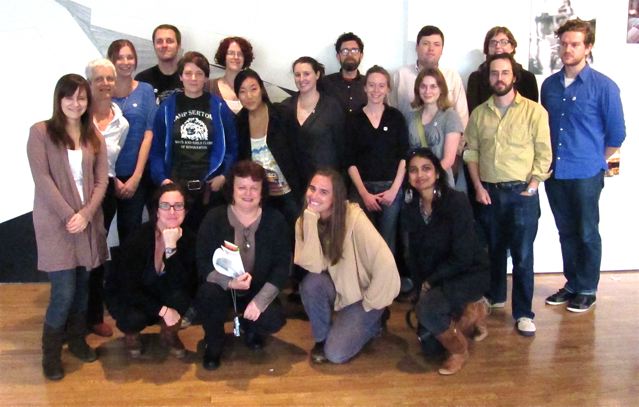
Walter Forsberg (NYU Research Fellow), Brian Graney and Karin Carlson (Northeast Historic Film), Alice Moscoso (NYU Film Preservation Specialist), and Katie Trainor (Museum of Modern Art Department of Film), all Home Movie Day veterans, organized. Katie is a Center for Home Movies board member and co-founder; Molly Wheeler (Yale Univ. Beinicke Library) is another HMD co-founder.   

This amazing crew of students from the New York University Moving Image Archiving and Preservation Program provided staff support for the entire day. Particular thanks to the film inspectors and the projectionists: Matt Barry, "The Art and Culture of Movies", http://artandcultureofmovies.blogspot.com and Zack Lischer-Katz, Archive Assistant at NYU's Cinema Studies Film Study Center. NYU professors Howard Besser, Dan Streible, and Mona Jimenez attended, too. Thank you, all.    

Individuals with home movies arrived before noon and kept coming. Many had heard about the event on WNYC radio as Leonard Lopate interviewed Walter Forsberg and Louise Weinberg on Oct. 14. Leonard has great listeners who can find their home movies with less than a day's notice. Listen here.   


We saw Kodachrome family fun, a 16mm 1953 wedding--a surprise to the son who brought it, both the 1939-1940 and the 1964 NY World's Fairs, Miami, Havana, teen birthday dancing (1960s), 8th grade graduation, lakes, Fire Island, and new NY highways (many people shot out their windshields). We enjoyed a special guest appearance by the film of Gus Martens, brought by his grandson, Robert Martens, who introduced. Gus Martens was an Amateur Cinema League Member. Mr. and Mrs. Martens talk to Walter Forsberg, below. 
Do you have home movies? Please consult these FILM PRESERVATION LINKS.

Thursday, August 25, 2011

PBCore Workshop at AMIA Conference

Wednesday, November 16, 2011
A full day at the Harry Ransom Center, The University of Texas at Austin
Association of Moving Image Archivists Annual Conference (Nov 16-19)

A PBCore Cataloging Workshop

  REGISTRATION IS CLOSED, WORKSHOP FULL   

"PBCore provides a level of detail useful to media archives, without being ridiculous to implement." --Jack Brighton.
PBCore is a metadata standard created for the description of analog and digital media objects. This workshop is an all-day followup to AMIA 2010 PBCore conference sessions that will enable catalogers and others to evaluate and prepare to adopt PBCore for management of their AV assets. We will include demonstrations of PBCore's value in handling intellectual content, rights, and technical metadata and will present specific case studies. Attendees will create PBCore records in custom exercises.

PBCore 2.0 was released in early 2011: The instructors will present the schema and uses in detail, from mandatory elements through newly-added attributes. PBCore can either include or reference data from other schemas; the workshop will look at its future in the semantic Web as well as practical entry-level steps to adoption.
Among other PBCore advantages is that its use is free to all and there are database tools already in use including a variety of open source software applications.

Presenters include PBCore experts Jack Brighton, New Media & Innovation, Illinois Public Media at WILL; Brian Graney, Media Cataloger at Northeast Historic Film; Dave Rice and Kara Van Malssen, audiovisual metadata specialists, Audiovisual Preservation Solutions.

Thanks to the Harry Ransom Center for hosting, AMIA conference program committee, and CLIR Cataloging Hidden Special Collections and Archives for supporting the workshop through a grant to Northeast Historic Film.

Friday, August 19, 2011

A Camera Chart for the Fair

The Amateur Cinema League's Movie Makers periodical published a "Camera Chart," actually an annotated schematic map, for the New York World's Fair in 1939. Cataloger Brian Graney identified and prepared the map as a signature element of our access and interpretive tools.

Website visitors will be able to use the map to browse amateur films by fair zones. The map, a two-page spread in the large-format magazine with another column identifying camera-worthy fair features, is also available for download as a PDF.

Locations on the map are numbered, for example at site 27, "The Parachute Jump will let you film while you are jumping." We have not yet noted a reel capturing a falling cameraperson.

Perhaps such reels will appear at the Home Movie Day event scheduled for Saturday, October 15, at Queens Museum of Art, in Queens, NY, from 1 to 5 p.m.

Home Movie Day at Queens Museum of Art is free to the public; anyone who has amateur film from the 1939-1940 fair, who attended the fair, and people of all ages interested in learning more about amateur film, please write to be added to the mailing list for our Home Movie Day event: brian@oldfilm.org

Sunday, July 24, 2011

Work Life final report wrapped and sent

Fifty new finding aids for moving image collections documenting work life between 1916 and 1960 have been published as EAD-encoded finding aids, with 1,081 reel descriptions using the PBCore metadata structure. The finding aids are here.

We hope this work will be helpful for both scholars encountering these records and for our peers seeking to solve their own hidden collections issues. Audiovisual texts are essential records for humanities research. This opportunity has been an important step. As Mark J. Williams, Dartmouth Film & Media Studies, says, “This project succeeds in relation to both stalwart commitment to preservation, and a progressive commitment to establish new modes of access and study, by working to realize standards that conjoin both analog and digital sets of tools for access, annotation, and the futures of moving image scholarship.”

There were delays with our database system due to the complexity of the original coding. We await a last deliverable, the CollectiveAccess OAI-PMH utility, to support the upload of records to WorldCat. This capability is promised by the developer for August.

ASSESSMENT EXCERPTS, full reports on request

1. Comments on Hidden Collections of Work Life databases
Martin Johnson, NYU Cinema Studies doctoral student

What you are doing is rare. Most moving image archives don’t offer stills. Need to answer the researchers’ question, “What do I have to do to see this material?” For close reading they will want to know, “How can I get to this (are there digital moving images?)”

Next steps
What about more organic gathering of collections, creating virtual collections, for example a Web-only aggregation of “Movie Queen” material. Or summer camps. Or Jewish summer camps. Also, a layer of community-created pages.

2. Intellectual Access to Moving Images of Work Life, 1916-1960, Assessment of Project Outcomes
David Rowntree, archival media consultant, Special Media Collections Archivist at Washington University, St. Louis (2001-2009)

….the experience gained from the Work Life project and successful integration of different metadata standards put NHF in a position to take a leading role in sharing strategies with other similar institutions. It would be a coveted position to be thought of as a leader in the profession, as IPI [Image Permanence Institute] is thought of for storage and preservation.
Establishing mechanisms to transfer generated knowledge and increase scholarly/informational output in the form of white papers, panel presentations, and articles in professional journals can enhance the reputation of NHF in the profession – both as a place that is generating scholarship from study and use of its collections, and as a place that is a leader in moving image archiving. This can include applying for grants to conduct research and create recommendations and best practice guidelines.

Next steps
There are two main paths the NHF should follow as it goes forward from the Work Life Project. The first focuses on the activities around the dissemination of the newly created resource and encouragement of scholarly access. The second path is derived from the lessons learned and experience of the project to position the institution as a center of excellence and leader in the profession.


3. Northeast Historic Film’s Work Life Collection: Its Uses and Benefits in Digital Education
Jim Wells, Maine Learning Technology Initiative, Dept. of Education

The ability to sort through the database by different criteria, such as place, industry, decade etc. as given on the Work Life homepage enables the student to find information faster, with more accuracy and with confidence.
Far from being an anonymous collection of clips, from which students must extract meaning and understanding, they are provided with detailed notes on contributors, dates, places and notes found with the films. In terms of citing the source this is invaluable, contributing to a deeper academic level earlier in the grades system.

Next steps
Georeference-based projects and video publications by students.


4. Assessment of the Project Intellectual Access to Moving Images of Work Life
Mark J. Williams, Department of Film and Media Studies, Dartmouth College

All of these critical questions and emphases are newly elaborated by the importance of the digital aspects of the Work Life project. Let me conclude by referencing several key factors in this aspect of the assessment. The format and design of the site is clean and recognizable, despite (or rather, clearly because of) its conceptual innovations. The stills selected to represent each film are distinctive and noteworthy, attracting attention and interest. Each is paired with a brief video excerpt that further elaborates the regional, period, and indexical value of each film. (Indeed, this paired format seems to echo the very spectacle of early film screenings, as still images that might seem of interest at one level, spring into motion and take on a “life” both unexpected and familiar.) The descriptive work for each entry is well-researched, copiously detailed, insightful, and elegant. A map feature for each entry is especially notable, literally “placing” the film in its local context, and therefore re-locating the text in a manner that accents and highlights both its historicized site of production and its relation to the mission of the archive.

Next steps
One could for example posit a set of research potentials between this project and other online archival projects, such as the Library of Congress site titled America at Work, America at Leisure. It is not difficult to imagine capacities for crowd/cloud annotations in relation to this project and the cluster of projects to which it will exist in relation. Various additional and related mappings and historical geospatial overlays are clearly within reach, as new scholars and audiences (or newly digitized older scholarship) are brought into interface with these materials. Indeed, this collection and project beg us to imagine the future and alternative functionality of research, and even entirely new areas of research that online access and networked capacities may generate.

Tuesday, June 28, 2011

Usability?! Performance Improvement Project

In Boston this summer? Interested in participating in a usability study to help us with functional evaluation of the public website for Moving Images 1938-1940: Amateur Filmmakers Record the New York World’s Fair and Its Period? Our Website is coming along in the capable hands of developer Maria Passarotti and media cataloger Brian Graney. It’s time to see how it will work for researchers.

Meagan Doyle, a Simmons GSLIS student in the archives concentration in library science, plans our usability study and, pending approval from the Institutional Review Board, will be in the Usability Lab with eight subjects in the third week of July.

Donna Webber, the Simmons College Archivist, is the faculty instructor for the Archives Field Study course, helping us along with Rong Tang, director of the Simmons GSLIS usability lab. Training in usability tools was with Jon Gray, below on left.
Meagan Doyle graduated from Bates College in Lewiston, Maine, where she worked with Kat Stefko at the Bates College Archives. Next semester she will take a course on library evaluation taught by Naresh Agarwal. We stopped in to see Prof. Agarwal for guidance on usability testing for our Website. Summer is pleasant on campus, and the faculty assistance has been cheerful.
Doyle has established a one-hour program for participants, who will sit at a keyboard and interact with the current version of the project Website. After brief orientation, subjects will carry out a set of tasks that will help us to see how the site structure is understood by researchers. The Fairfilm site will offer collection finding aids, item-level metadata, and selected digital surrogates of 16 mm. and 8 mm. films. Can you find them? What about the information on the New York World’s Fair in 1939-1940? And how about resources for cataloging?

As Meagan Doyle suggests, “As more libraries and archives make their material available on the web, it is important for LIS professionals to have the skills necessary to evaluate these services.” Hands-on in the lab with Morae software recording interactions between users and incipient library resources is a great way to learn. We look forward to what the study reveals.

Participants will be recruited from GSLIS classes as well as archival repositories in the area, and will be offered the incentive of a $25 gift card in appreciation of time and effort.

Friday, May 27, 2011

Boston AV Cataloging Workshop Scheduled for Sept. 27

This workshop is fully enrolled. (29 August 2011)

For special collections, historical society and archives managers and staff, lone arrangers, LIS students.

Register here (bottom of page) http://conta.cc/jivZpJ

--Are you responsible for analog and digital audiovisual collections?

--Do you want to create and share catalog records using common content standards?

--Are you ready to explore PBCore?

Find out how to deal with moving images like these:

  • 16mm football films might thrill the Development office
  • Videos for course-related screenings and research
  • VHS oral histories crying out for transfer
  • Thesis films (or what is really in those cans?)
  • ¾-inch video community cable collections
  • Promotional AV and corporate works in all media

Full-day workshop with hands-on introduction to content standard and data structure selection for moving images (film and video).

We will concentrate on PBCore, the metadata standard established in 2005 specifically for audiovisual media assets and rapidly gaining a community of practice; and its use in conjunction with DACS (Describing Archives: A Content Standard) to help support findability--and more efficient management of your analog and digital audiovisual holdings.

Workshop will include demonstrations of PBCore’s value in describing intellectual content, rights, and technical metadata; discussion of “More Product, Less Process” decisionmaking for under-resourced AV collections; explore implementation of DACS/EAD and PBCore through an open-source collection management system.

Instructors

Brian Graney, Media Cataloger, Northeast Historic Film. MLS from SUNY Buffalo. Graduate of the L. Jeffrey Selznick School of Film Preservation at George Eastman House. Served as Director of the Board, Association of Moving Image Archivists; also Co-founder and Board Member of the Center for Home Movies. Past positions include Senior Archivist, New Mexico State Records Center and Archives; and Film Preservation Technician, UCLA Film and Television Archive.

Andrea Leigh, Head, Moving Image Processing, Library of Congress, Packard Campus for Audio Visual Conservation. B.A., Theater Arts, and MLIS from UCLA. Leigh has published articles on the description and cataloging of archival moving images in a variety of publications, comments and consults widely on metadata standards for the description of moving image resources, and is active in AMIA, SAA, and ALA. Previously she was Catalog and Metadata Librarian, UCLA Film & Television Archive (2000-2008).

Courtney Michael, Project Manager, WGBH Media Library & Archives. MA in US History and an MLS (University of Maryland). Manages WGBH’s Mellon-funded digital library project. Also manages the American Archive Content Inventory Project team at WGBH; funded by CPB to collect PBCore compliant records from public media repositories nationwide. Producer for the redesign of PBCore.org, the metadata dictionary site, and consulted on the NOVA Web site re-design regarding subject selection, metadata structure, and cross-walking with other taxonomies.

Boston TV film cansTO BE HELD AT
Simmons Graduate School of Library and Information Sciences Tech Lab, 1 Palace Road Building, second floor, Room P-213. Please arrive promptly by 9 a.m. to register. Coffee available in the morning.

Public Transportation Suggested: MBTA Green Line E train outbound Heath Street/Arborway to the Museum stop. Exit train. Take a right onto Louis Prang Street and walk past the Isabella Stewart Gardner Museum.

Drivers, on campus parking is available for $12 additional at time of registration only. Without prior registration, Simmons parking is $50/day. Or find a local metered spot.

Directions at http://www.simmons.edu/gslis/about/maps/directions.php#boston

Wednesday, May 11, 2011

Instantiations: Formatted Data and Narrative


 [1938 Kodachrome of NYC + Jones Beach] 1999:0078:0001, George Eastman House
A drive by the New York World's Fair site under construction

Students at the L. Jeffrey Selznick School of Film Preservation, George Eastman House, are trained in film handling and inspection. What information gathered during film inspection will we pass on to researchers in our catalog records, and what do researchers want to know? First, a reminder about the PBCore structure. Each reel has one Intellectual Content record, a set of elements describing what the reel is about, independent of its physical or digital existence. Each reel also has one or more Instantiation records, consisting of technical metadata describing the asset’s physical attributes (format, condition, location).

As skilled film handlers, the Selznick School students identified and captured information that tells us not only its present condition, but about its creation: often there are date codes indicating what year the film stock was created, and sometimes camera codes that reveal the type of camera used. Splices can tell how the creator edited the film, and whether a reel may come from one or more sources. Assessing condition, in particular shrinkage or vinegar syndrome, guides the custodians as to care of the artifact. The Instantiation record for the original material is important from a conservation point of view, and potentially holds information of interest to researchers, for example, was the reel shot on 8 mm. or 16 mm. film?

[1938 Kodachrome of NYC + Jones Beach] 1999:0078:0001
George Eastman House

Some Instantiation information is easily captured in structured fields as we are presently doing using PBCore’s formatPhysical element. Use of picklists and formatted elements ensures consistency in the data collected. However, our discussion indicates there may be a place for a more complex Instantiation narrative; as one student points out, “Some things like the film being upside down and our not being able to determine if that was intentional.”
NHF Media Cataloger Brian Graney shared film inspection notes recorded by Bob Brodsky while transferring a film from the Charles Gilbert Collection, “not simply documenting the number and types of splices. A speculative story about the process based on the evidence in the film.” Graney posits that such narrative “may not be possible or useful in every case so it may be that two different types of technical description could exist side by side--the basic description, element by element--where that’s sufficient to record. That supplemented by a narrative statement where something becomes clear."

The students had strong arguments for both formatted metadata and for narrative about the material condition:

...there can be some uniform information. Like boxes or bullets. Then there can be some space for small narrative. So the inspector is not being redundant, so if you have shrinkage space you are not repeating information in the narrative, but if you want to tell something else you have space.
We discussed how much of the PBCore Instantiation data should be presented directly to the researcher. While one student felt an unprepared researcher would find this information "chaos," another felt that the physical description was important to understanding the nature of the record, what it is, how it was made, and what kind of care original film requires:
Why should that be hidden from the users? Its part of the story of the film....And also it’s part of educating the users about what the film is and the fact that it has splices and they can come apart. And it’s old and it changes color and all this kind of thing. For this project I think the narrative works.1939 NY World's Fair--Jeanne at Y camp--home movies] T200.1.442WF39
Queens Museum of
The consensus from the Selznick School discussion may be that a structured Instantiation record gathers baseline technical information, supplemented by a narrative in the Annotation element expanding on the inspectors’ findings. For analog assets such as camera original amateur films, careful and knowledgeable inspection of the film and its box or can gathers valuable information left behind once a digital copy is made.